
Monday, April 13, 2026 From rOpenSci (https://deploy-preview-1283--ropensci.netlify.app/blog/2026/04/13/reviser/). Except where otherwise noted, content on this site is licensed under the CC-BY license.
Economic data are rarely static. Gross domestic product (GDP), inflation, employment, and other official statistics arrive as early estimates, then get revised as new source data arrive, seasonal adjustment is updated, or benchmarking changes are applied. Those revisions matter because they can change the narrative around turning points, policy mistakes, and forecast performance.
reviser is an R package by Marc Burri and Philipp Wegmüller for working with these vintage datasets directly.
A vintage dataset records multiple published versions of the same time series, so you can compare what was known at each release date with what was reported later.
reviser gives you a consistent workflow to:
- reshape release vintages between wide and tidy formats;
- extract revisions relative to earlier or final releases;
- summarize bias, dispersion, and serial dependence in revisions;
- identify the first release that is statistically close to the eventual benchmark;
- nowcast future revisions with state-space models.
The package is aimed at users who already work with real-time macroeconomic data and want tools that go beyond plotting revision triangles by hand. One design goal is to keep that workflow in pure R.
reviser was reviewed through rOpenSci statistical software peer review.
Many thanks to reviewers Alex Gibberd, and Tanguy Barthelemy, and to editor Rebecca Killick, for feedback that improved the package.
🔗 Why revision analysis deserves its own workflow
Revisions are not just measurement noise. They encode how information enters the data-production process.
- Some revisions reflect genuinely new information.
- Others reflect noise that could, in principle, have been reduced earlier.
- Still others come from methodological changes or benchmark updates.
These distinctions matter if you are evaluating early data releases, building nowcasts, or asking whether first releases are already efficient summaries of the available information.
The reviser vignettes organize this workflow into three layers:
- Structure vintages consistently.
- Measure and test revision properties.
- Model the revision process when you want to predict future changes.
🔗 A compact example with GDP vintages
The first step is to reshape the data into a tidy vintage format, where each row corresponds to an observed value, the date it refers to, and the publication date of that estimate.
The package ships with a GDP example dataset in long vintage format. Suppose we want to focus on U.S. GDP growth, visualize how estimates moved during the 2008-09 global financial crisis, and then ask whether early releases were systematically biased relative to a later benchmark.
library(reviser)
library(dplyr)
library(tsbox)

gdp_us <- gdp |>
  filter(id == "US") |>
  tsbox::ts_pc() |>
  tsbox::ts_span(start = "1980-01-01")

gdp_wide <- vintages_wide(gdp_us)
gdp_long <- vintages_long(gdp_wide, keep_na = FALSE)
With the vintages in tidy form, we can plot how the published path changed over time. The y-axis in the figure reports quarter-on-quarter GDP growth rates.
plot_vintages(
  gdp_long |>
    filter(
      pub_date >= as.Date("2009-01-01"),
      pub_date < as.Date("2010-01-01"),
      time > as.Date("2008-01-01"),
      time < as.Date("2010-01-01")
    ),
  type = "line",
  title = "Revisions of GDP during the 2008-09 global financial crisis",
  ylab = "Quarter-on-quarter GDP growth rate"
)
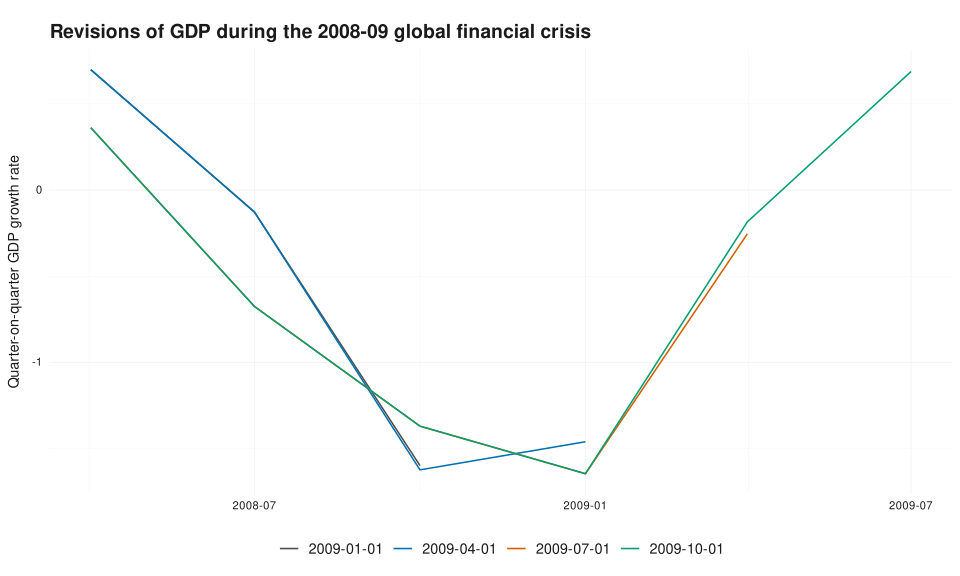
GDP growth vintages for the United States during the 2008-09 global financial crisis.
During volatile periods, the vintage paths can diverge enough that the story told by the first release is noticeably different from the story told a year later.
Once the data are in tidy vintage form, you can compare a set of early releases to a later benchmark release.
final_release <- get_nth_release(gdp_long, n = 10)
early_releases <- get_nth_release(gdp_long, n = 0:6)

summary_tbl <- get_revision_analysis(early_releases, final_release)
Warning: Both 'release' and 'pub_date' columns are present in 'df.
      The 'release' column will be used for grouping.
summary_tbl |>
  select(id, release, `Bias (mean)`, `Bias (robust p-value)`, `Noise/Signal`)
=== Revision Analysis Summary ===

# A tibble: 7 × 5
  id    release   `Bias (mean)` `Bias (robust p-value)` `Noise/Signal`
  <chr> <chr>             <dbl>                   <dbl>          <dbl>
1 US    release_0        -0.014                   0.52           0.22
2 US    release_1        -0.015                   0.425          0.202
3 US    release_2        -0.013                   0.507          0.205
4 US    release_3        -0.003                   0.851          0.194
5 US    release_4        -0.014                   0.326          0.157
6 US    release_5        -0.021                   0.181          0.152
7 US    release_6        -0.018                   0.202          0.13

=== Interpretation ===

id=US, release=release_0:
  • No significant bias detected (p = 0.52 )
  • Moderate revision volatility (Noise/Signal = 0.22 )

id=US, release=release_1:
  • No significant bias detected (p = 0.425 )
  • Moderate revision volatility (Noise/Signal = 0.202 )

id=US, release=release_2:
  • No significant bias detected (p = 0.507 )
  • Moderate revision volatility (Noise/Signal = 0.205 )

id=US, release=release_3:
  • No significant bias detected (p = 0.851 )
  • Moderate revision volatility (Noise/Signal = 0.194 )

id=US, release=release_4:
  • No significant bias detected (p = 0.326 )
  • Moderate revision volatility (Noise/Signal = 0.157 )

id=US, release=release_5:
  • No significant bias detected (p = 0.181 )
  • Moderate revision volatility (Noise/Signal = 0.152 )

id=US, release=release_6:
  • No significant bias detected (p = 0.202 )
  • Moderate revision volatility (Noise/Signal = 0.13 )
This is where reviser moves beyond a reshape-and-plot package.
The revision summary reports quantities that applied work often needs but usually rebuilds ad hoc: mean bias, quantiles, volatility, noise-to-signal ratios, and hypothesis tests for bias, serial correlation, and news-versus-noise interpretations.
In the bundled example, the early U.S. GDP releases over this sample show little evidence of systematic bias relative to the later benchmark. The package also supports efficient-release diagnostics, where the question is not only whether revisions exist, but when additional revisions stop adding meaningful information.
efficient_release <- get_first_efficient_release(early_releases, final_release)
summary(efficient_release)
Efficient release:  0

Model summary:

Call:
stats::lm(formula = formula, data = df_wide)

Residuals:
     Min       1Q   Median       3Q      Max
-0.89186 -0.12669  0.02046  0.11475  0.97986

Coefficients:
            Estimate Std. Error t value Pr(>|t|)
(Intercept)  0.00299    0.02223   0.134    0.893
release_0    0.97412    0.01692  57.567   <2e-16 ***
---
Signif. codes:  0 '***' 0.001 '**' 0.01 '*' 0.05 '.' 0.1 ' ' 1

Residual standard error: 0.2518 on 166 degrees of freedom
  (10 observations deleted due to missingness)
Multiple R-squared:  0.9523,	Adjusted R-squared:  0.952
F-statistic:  3314 on 1 and 166 DF,  p-value: < 2.2e-16


Test summary:

Linear hypothesis test:
(Intercept) = 0
release_0 = 1

Model 1: restricted model
Model 2: final ~ release_0

Note: Coefficient covariance matrix supplied.

  Res.Df Df      F Pr(>F)
1    168
2    166  2 1.9283 0.1486
That is exactly the kind of result that is hard to see from a revision triangle alone but straightforward to formalize once the workflow is standardized. In this sample, the result points to the first release as already being statistically close to the later benchmark, which suggests subsequent revisions add relatively little systematic information.
🔗 From descriptive analysis to revision nowcasting
For many users, revision summaries will be the main use case.
But reviser also includes model-based tools for users who want to treat revisions as an explicit latent-data problem.
That matters if you need to make decisions on preliminary data but also want a structured way to estimate how those figures are likely to change later.
Two vignettes walk through nowcasting revisions with:
- the generalized Kishor-Koenig family via
kk_nowcast(); - the Jacobs-Van Norden model via
jvn_nowcast().
Both approaches cast the revision problem into state-space form, which makes it possible to estimate the dynamics of news and noise in successive data releases. For technical users, this is the part of the package that turns revision analysis from retrospective diagnosis into a forecasting problem.
Here is a compact kk_nowcast() example following the Kishor-Koenig workflow from the vignette for the Euro Area (EA).
The key idea is to first identify an efficient release e, then estimate the revision system on the corresponding panel of releases.
In this euro area example, the efficient-release step selects e = 2, so the model treats the third published release as the earliest one that is already close to the later benchmark.
That is a useful substantive result on its own: it suggests that most of the economically relevant signal arrives within the first few releases, while later revisions are smaller adjustments around that path.
gdp_ea <- reviser::gdp |>
  tsbox::ts_pc() |>
  dplyr::filter(
    id == "EA",
    time >= min(pub_date),
    time <= as.Date("2020-01-01")
  )

releases <- get_nth_release(gdp_ea, n = 0:14)
final_release <- get_nth_release(gdp_ea, n = 15)

efficient_release <- get_first_efficient_release(releases, final_release)

fit_kk <- kk_nowcast(
  df = efficient_release$data,
  e = efficient_release$e,
  model = "KK",
  method = "MLE"
)

summary(fit_kk)
=== Kishor-Koenig Model ===

Convergence: Success
Log-likelihood: 125.7
AIC: -231.41
BIC: -198.23

Parameter Estimates:
 Parameter Estimate Std.Error
        F0    0.633     0.131
      G0_0    0.950     0.031
      G0_1   -0.037     0.152
      G0_2   -0.181     0.220
      G1_0   -0.009     0.011
      G1_1    0.594     0.061
      G1_2    0.194     0.092
        v0    0.380     0.068
      eps0    0.008     0.001
      eps1    0.001     0.000
plot(fit_kk)
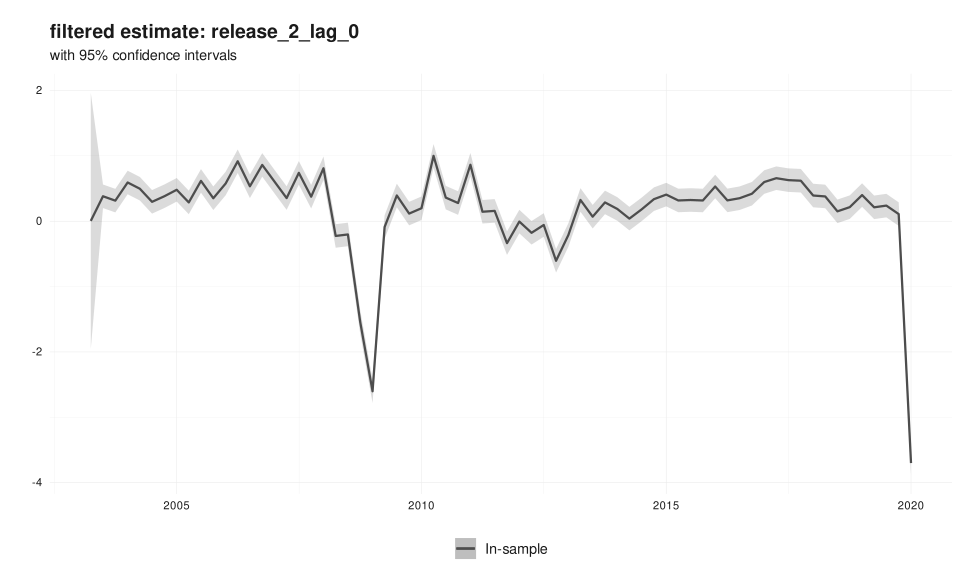
Diagnostic plot from the Kishor-Koenig nowcast example.
The fitted object contains estimated parameters, filtered and smoothed latent states, and plotting methods for the implied efficient-release path. That gives you a direct route from descriptive revision analysis to a state-space nowcast of future revisions. For a broader audience, the main takeaway is not the individual coefficients. It is that the model converges cleanly on this sample, summarizes the revision process in a compact latent-state form, and provides a practical way to judge whether a new release is likely to be revised materially later on. Substantively, the model separates persistent signal from transitory revision noise, so the output is useful when you want to judge whether new releases are likely to be revised materially.
🔗 What reviser adds
What stands out in reviser is not a single function, but the coherence of the workflow:
- the package has explicit conventions for vintage data;
- descriptive revision analysis and formal testing sit in the same API;
- efficient-release analysis connects directly to applied questions about which release to trust;
- nowcasting tools extend the same workflow rather than forcing a separate modeling stack.
If you work with real-time macroeconomic data, that combination is useful because revision analysis is usually fragmented across custom scripts, one-off spreadsheets, and package combinations that do not share a common data structure.
🔗 Try it and push it further
You can install the package from the rOpenSci R-universe:
install.packages(
  "reviser",
  repos = c("https://ropensci.r-universe.dev", "https://cloud.r-project.org")
)
Then start with the package site and vignettes:
We would be happy to hear feedback from those of you trying out the package with different datasets. If you have a real-time dataset with a different release structure, that would be a good stress test for the package. If you find gaps in the workflow or have a use case to share, open an issue or contribute an example. Revision analysis gets more useful as it becomes easier to compare workflows across datasets rather than rebuilding them from scratch each time.
Filed under
Suggest an edit
Open a pull request
